Night Sweats at Night: What’s Actually Causing Them (And What Helps)
Waking up sweaty at 2 or 3am—throwing the covers off, flipping the pillow, trying to cool down—only to repeat the whole thing again an hour later?
Yeah. That’s not in your head.
Night sweats are one of the most common (and most disruptive) symptoms during perimenopause. And they’re often the reason your sleep starts falling apart.
But here’s the part most people miss:
👉 It’s not just about temperature.
There’s a deeper reason this is happening—and once you understand it, you can actually do something about it.
Why do night sweats happen during perimenopause?
Night sweats during perimenopause are caused by hormonal fluctuations—especially changes in estrogen—that affect your body’s temperature regulation and nervous system stability.
As estrogen shifts, your body becomes more sensitive to small changes in internal temperature.
What used to feel neutral now feels like:
- too hot
- too sudden
- too intense
So your body reacts fast—by trying to cool itself down.
Which is why you wake up sweating, even if your room temperature hasn’t changed at all.
Night sweats during perimenopause are caused by hormonal fluctuations—especially changes in estrogen—that affect your body’s temperature regulation and nervous system stability.
As estrogen shifts, your body becomes more sensitive to small changes in internal temperature.
What used to feel neutral now feels like:
- too hot
- too sudden
- too intense
So your body reacts fast—by trying to cool itself down. Which is why you wake up sweating, even if your room temperature hasn’t changed at all.
Why do night sweats wake you up in the middle of the night?
Night sweats often wake you up because your body’s temperature spike triggers a stress response, pulling you out of deeper sleep.
This is where night sweats become more than just uncomfortable.
They don’t just happen—they interrupt your sleep cycle.
When your body overheats:
- your heart rate can increase
- your nervous system activates
- your body shifts out of deep sleep
And once you’re awake, it’s not always easy to fall back asleep.
That’s how you end up:
- waking up multiple times
- feeling exhausted even after “sleeping”
- stuck in that light, broken sleep pattern
Why night sweats feel worse at certain times
Night sweats often feel worse in the early morning hours because that’s when hormonal fluctuations and cortisol shifts are most active.
If you’ve noticed this happening around 2–4am, you’re not imagining it.
That’s when:
- cortisol starts to rise
- body temperature regulation becomes more sensitive
- sleep is naturally lighter
So even a small disruption can wake you up fully. (This is also why night sweats and 3am wakeups often show up together.)
Why most advice for night sweats doesn’t actually help
Most advice focuses only on external cooling, but night sweats are driven by internal hormonal and nervous system changes.
You’ve probably heard:
- keep the room cooler
- wear lighter pajamas
- use breathable sheets
Sure—that helps a little.
But it doesn’t address:
- why your body is overheating in the first place
- why your nervous system reacts so quickly
- why your sleep doesn’t recover afterward
So you end up managing symptoms instead of fixing the pattern.
This is exactly where the Restore pillar of the Venvy Method comes in—focusing on sleep, recovery, and nervous system support so your body can regulate more effectively overnight.
What actually helps reduce night sweats
Reducing night sweats requires supporting your body’s temperature regulation, stabilizing your system before bed, and calming your nervous system overnight.
This is where small, targeted shifts make a difference:
- Supporting blood sugar stability before bed
- Reducing late-night stimulation (light, stress, noise)
- Creating a consistent wind-down routine
- Supporting your nervous system so it doesn’t overreact
It’s less about doing everything—and more about doing the right things consistently.
Because when your system feels more stable, those spikes become less intense.
Why night sweats are often part of a bigger sleep pattern
Night sweats rarely happen in isolation—they’re usually part of a broader pattern that includes disrupted sleep, early waking, and nervous system activation.
If you’re dealing with night sweats, you’re probably also noticing:
- waking up at 3am
- feeling tired but wired at night
- lighter, less restorative sleep
👉 These are all connected.
They’re different expressions of the same underlying shift.
If you haven’t read them yet:
These patterns tend to show up together—and they need to be addressed together.
How to reset your sleep when night sweats are involved
The fastest way to improve sleep with night sweats is to identify your main disruptor and apply simple, consistent adjustments that support your body overnight.
This is where most people get stuck.
You try:
- cooling hacks
- supplements
- random advice
But without clarity, it’s just guesswork.
The Peri Sleep Reset is designed to cut through that.
It helps you:
- identify what’s actually disrupting your sleep
- understand your specific pattern
- make targeted changes that fit your life

When sleep issues go beyond just night sweats
If sleep disruption is part of a broader pattern of low energy, inconsistency, or burnout, a more complete approach may be needed.
Sleep is often the first thing to break—but it’s rarely the only thing.
If you’re also feeling:
- off during the day
- inconsistent with routines
- like nothing is really “working” anymore
That’s a bigger signal.
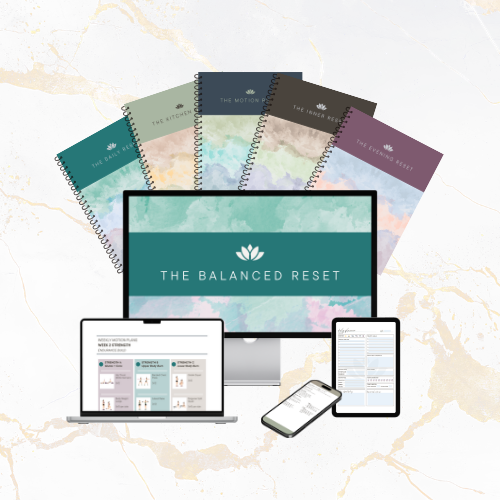
The Balanced Reset by Venvy Lab expands beyond sleep to support your full day—so your energy, movement, and recovery actually work together.
The bottom line
Night sweats aren’t random—they’re your body’s way of signaling that something needs support.
You don’t need to:
- panic
- overhaul everything
- try 10 new things at once
You just need to understand what’s happening—and respond in a way that actually supports your body.
That’s where things start to shift.